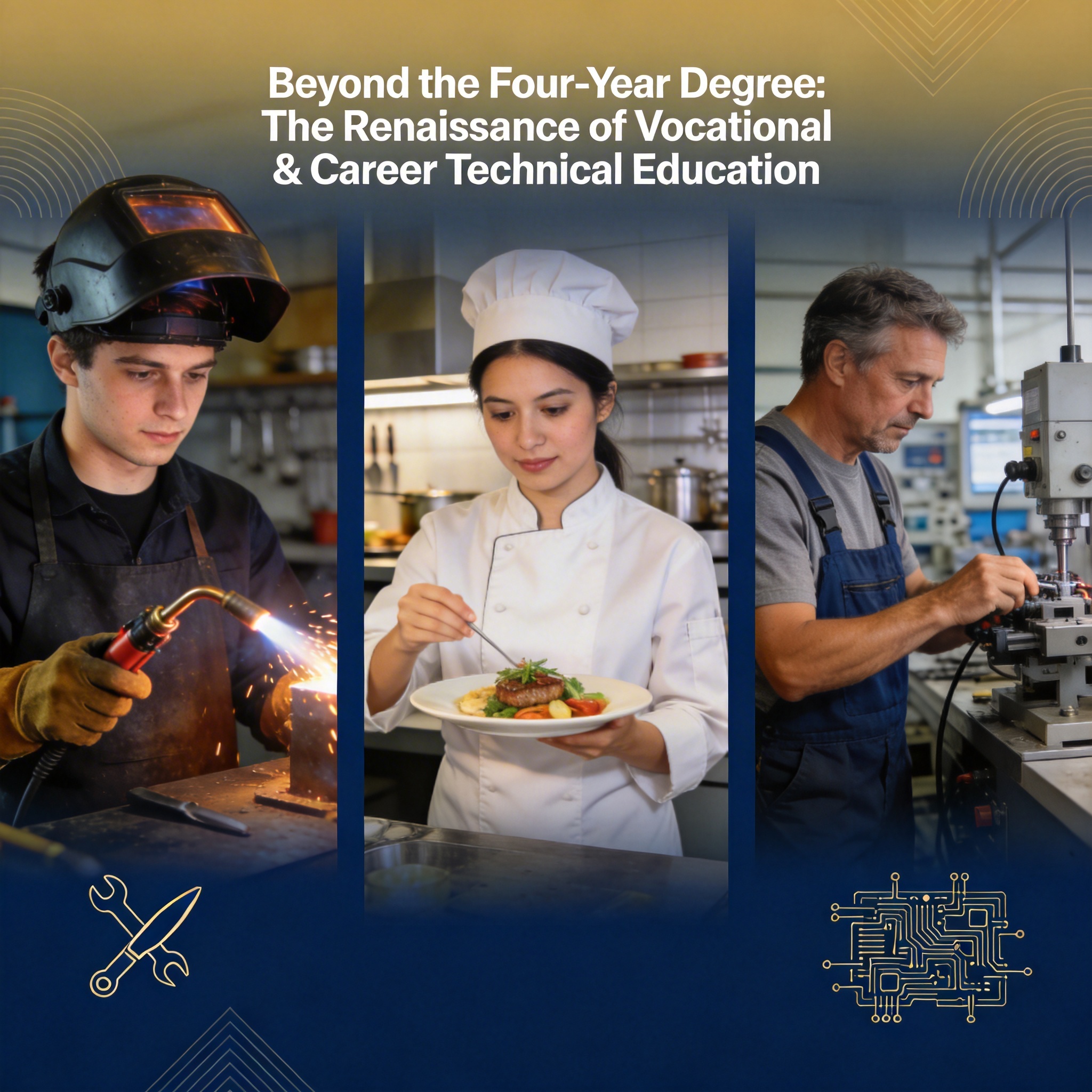
For decades, the dominant narrative in education and career counseling has been unequivocal: to succeed in the modern economy, one must obtain a four-year bachelor’s degree. This “college for all” mentality steered generations of students away from workshops and laboratories and into lecture halls, often resulting in crippling debt and degrees that did not align with the realities of the job market. However, as the global economy undergoes a massive transformation driven by technology, demographics, and shifting workforce needs, a quiet revolution is taking place. Vocational & Career Technical Education (CTE) is shedding its outdated stigma and emerging as a powerful, pragmatic, and essential pathway to prosperity. It is no longer a “second choice” for those who cannot handle traditional academia; it is a strategic first choice for those who wish to master the skills that power the world.
Understanding the Modern Landscape of Vocational & Career Technical Education
To appreciate the resurgence of Vocational & Career Technical Education, it is vital to understand what it actually encompasses today. Gone are the days when “vocational school” was synonymous solely with auto repair or woodworking. While those trades remain critical and highly sophisticated, modern CTE has expanded to include a vast array of industries such as healthcare, information technology, advanced manufacturing, renewable energy, cybersecurity, and graphic design. These programs offer a curriculum that is rigorous, relevant, and deeply integrated with the needs of local and global industries.
The defining characteristic of CTE is its approach to learning. While traditional education often prioritizes theoretical knowledge delivered through lectures and textbooks, CTE emphasizes competency-based, hands-on learning. Students do not just learn about concepts; they apply them. In a CTE classroom, a student studying HVAC does not merely memorize thermodynamic principles; they diagnose and repair actual climate control systems. A cybersecurity student does not just read about firewalls; they build and breach them in simulated environments. This pedagogical style bridges the gap between abstract theory and concrete application, ensuring that students graduate not just with knowledge, but with the demonstrable ability to perform tasks that employers value immediately.
Furthermore, the structure of CTE programs offers a flexibility that traditional universities often lack. Many CTE pathways are designed as “stackable credentials.” A student might earn a certificate in a specific skill in a few months, enter the workforce, and then return later to earn an associate degree or specialized certification to advance their career. This modular approach allows learners to adapt to changing economic conditions without having to commit to a four-year hiatus from the workforce. It creates a model of lifelong learning, where education is a continuous thread woven throughout a career, rather than a single event that occurs at the beginning of adulthood.
Bridging the Skills Gap: The Economic Imperative
One of the most compelling arguments for the expansion of Vocational & Career Technical Education is the sheer magnitude of the “skills gap” facing the global economy. Employers across virtually every sector are reporting a critical shortage of qualified workers to fill middle- and high-skill jobs. These are positions that require specialized training beyond high school but do not necessarily require a four-year liberal arts degree. According to various industry reports, millions of these jobs go unfilled annually, stifling economic growth and productivity.
This gap is particularly acute in the infrastructure and manufacturing sectors. As the United States and other nations grapple with aging infrastructure and a push for green energy, the demand for skilled electricians, plumbers, welders, and wind turbine technicians is skyrocketing. These roles are not low-wage labor; they are highly technical, safety-critical professions that command impressive salaries and benefits. Similarly, in the healthcare sector, the aging population is driving an unprecedented need for medical assistants, licensed practical nurses, and radiologic technologists. Vocational institutions are the primary engines capable of training this workforce quickly and efficiently.
Unlike traditional university programs, which can take years to adjust their curricula to market trends, CTE institutions are agile. They rely heavily on advisory boards composed of industry professionals who help design the curriculum. This ensures that the skills being taught are the skills currently in demand. When a new programming language becomes the industry standard or a new medical technology is adopted, CTE programs can pivot rapidly to incorporate these changes. This symbiotic relationship between education and industry ensures that graduates are “work-ready” from day one, reducing the training burden on employers and increasing the employability of the graduate.
Moreover, CTE serves as a vital engine for social mobility. By lowering the barriers to entry for high-paying careers—such as the time commitment and cost associated with a four-year degree—CTE opens doors for populations that have historically been underserved by traditional higher education. Non-traditional students, veterans transitioning to civilian life, and individuals from lower-income backgrounds can utilize CTE to gain a foothold in the middle class without the specter of crushing student loan debt hanging over them.
The ROI of CTE: A Smart Financial Decision
The conversation about education cannot be separated from the conversation about return on investment (ROI). In recent years, the astronomical rise in college tuition has forced students and families to scrutinize the financial viability of a four-year degree. The narrative that a bachelor’s degree guarantees a higher salary is increasingly being challenged by the reality of the job market. In contrast, Vocational & Career Technical Education offers a compelling financial value proposition.
First, the cost of CTE programs is significantly lower than that of traditional universities. Community colleges, trade schools, and technical institutes generally charge a fraction of the tuition of four-year institutions. Consequently, students often graduate with little to no debt. This financial freedom allows CTE graduates to start building wealth earlier—buying homes, saving for retirement, and investing in their communities—while their peers in traditional universities are often just beginning to pay off loans.
Secondly, the time to enter the workforce is drastically reduced. A typical bachelor’s degree takes four years; many CTE programs can be completed in six months to two years. This means a CTE graduate enters the workforce and starts earning a salary two to three years before a university student. When you calculate the “opportunity cost”—the money not earned during those extra years of study—the financial advantage of CTE becomes even more pronounced. A welder or a dental hygienist can be well into their career, earning promotions and raises, by the time a university student is just handing out their first resume.
It is also important to dispel the myth that vocational careers lead to a “ceiling” on earnings. While entry-level salaries are competitive, the potential for growth in technical fields is immense. Skilled tradespeople can become foremen, project managers, or business owners. IT specialists can climb the ladder to systems architecture or cybersecurity leadership. The combination of technical skill and experience is often more highly valued in these sectors than a generic degree, allowing for rapid advancement based on merit and performance.
Integrating Soft Skills and Critical Thinking
A common misconception about Vocational & Career Technical Education is that it focuses solely on manual or technical tasks at the expense of critical thinking and soft skills. This could not be further from the truth. Modern CTE places a heavy emphasis on “employability skills”—the intangible qualities that make a worker valuable. Communication, teamwork, problem-solving, and adaptability are woven into the fabric of CTE curricula.
In a technical program, students rarely work in isolation. They collaborate on projects, troubleshoot complex problems together, and often interact with clients or customers during their training. For example, a student in an automotive technology program must