Beyond the Road: How Autonomous Vehicles and Drones Are Intertwining to Reshape Our Future
Imagine a world where your morning commute involves reclining in your personal vehicle while it navigates rush hour with effortless precision, simultaneously receiving a live video feed from a drone patrolling your neighborhood for potential hazards. This isn’t science fiction; it’s the rapidly approaching reality driven by the converging forces of Autonomous Vehicles (AVs) and drones (UAVs – Unmanned Aerial Vehicles). While often discussed separately, these technologies are increasingly interdependent, creating a powerful synergy that promises to revolutionize transportation, logistics, safety, and even urban planning. The true magic lies not just in each technology evolving in isolation, but in how they actively enhance and enable each other, forming a cohesive ecosystem of intelligent mobility. Understanding this intersection is crucial, as it holds the key to unlocking benefits far beyond what either technology could achieve alone.
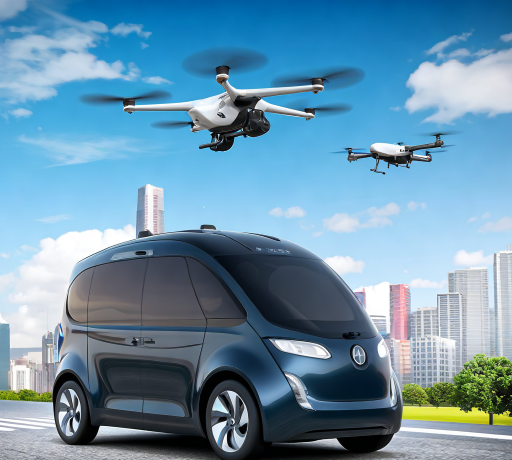
The evolution of autonomous vehicles, from experimental prototypes to limited commercial deployments, has been primarily ground-based. Companies like Waymo, Cruise, and Argo AI have focused on mastering the complexities of navigating streets filled with unpredictable human drivers, pedestrians, and cyclists. Simultaneously, the drone industry has exploded, moving far beyond recreational use. Industrial drones now inspect pipelines, monitor construction sites, and survey agricultural fields with unprecedented efficiency. Delivery drones, pioneered by companies like Wing (Alphabet) and Zipline (focusing on medical supplies in remote areas), are beginning to touch consumer lives. However, the most transformative developments are emerging at the *intersection*. AVs provide the critical ground infrastructure needed for drone operations. Think of a self-driving van equipped with drones: it travels to a location, deploys a drone for a rapid aerial inspection or package drop-off in hard-to-reach places, then retrieves the drone and moves on. This “mobility-as-a-platform” concept leverages the AV’s range and carrying capacity, turning it into a mobile launchpad and retrieval station, vastly expanding the operational envelope for drones. Conversely, drones are becoming essential eyes and ears for AVs. High-resolution aerial imagery captured by drones can update HD maps in near real-time, providing AVs with crucial information about road closures, construction zones, or temporary obstacles that static maps cannot capture quickly enough. During emergencies, drones can scout disaster areas, guiding autonomous emergency vehicles through debris-strewn routes.
This synergy extends deeply into the realm of safety and infrastructure management, arguably one of the most immediate and impactful applications. Autonomous vehicles inherently promise significant safety improvements by removing human error, the leading cause of accidents. However, their sensor suites (cameras, lidar, radar) have limitations, especially in adverse weather or when obscured by large vehicles. Drones offer a complementary perspective. A network of drones can provide a dynamic, bird’s-eye view of traffic flow, identifying congestion, accidents, or hazards long before an individual AV encounters them. This data, integrated into the AV’s decision-making system via V2X (Vehicle-to-Everything) communication, allows for proactive route adjustments and safer navigation. Furthermore, drones are revolutionizing infrastructure inspection. Instead of sending crews in cherry pickers or closing lanes, autonomous drones