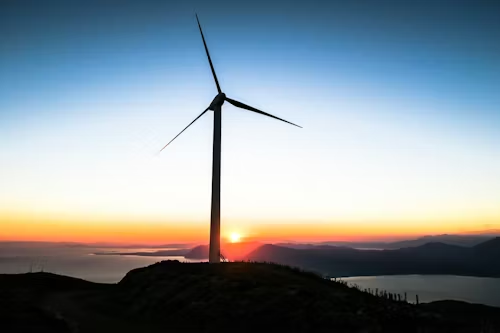
Imagine a world where your electricity comes from the sun beating down on rooftops and vast deserts, where wind turbines spin gracefully across horizons, powering cities without a puff of smoke, and where the very water we drink isn’t threatened by fossil fuel extraction. This isn’t science fiction; it’s the rapidly accelerating reality driven by Clean Energy Technology (CET). Far more than just solar panels, CET encompasses a dynamic ecosystem of innovations designed to generate, store, transmit, and utilize energy with minimal environmental impact – primarily by harnessing renewable sources like sunlight, wind, water, geothermal heat, and sustainable biomass. The urgency couldn’t be clearer: the climate crisis, driven overwhelmingly by fossil fuel emissions, demands a swift and decisive transition. Clean energy tech isn’t just an option; it’s the essential engine powering our path towards a stable climate, cleaner air and water, energy independence, and long-term economic resilience. The good news? This isn’t a distant dream. CET is here, it’s maturing rapidly, and its cost curves are plummeting, making the clean energy future increasingly accessible and inevitable.
The most visible pillars of CET – solar photovoltaics (PV) and wind power – have undergone transformative evolution. Solar panel efficiency has soared, while manufacturing scale and technological refinements have driven costs down by over 80% in the last decade, making solar one of the cheapest electricity sources in history for many regions. Wind power, both onshore and increasingly powerful offshore installations, follows a similar trajectory, with larger, more efficient turbines generating significantly more power per unit. But the true revolution lies beyond generation alone. Energy storage is the critical enabler that solves the “intermittency” challenge often associated with renewables. Lithium-ion batteries, dominant in electric vehicles and grid-scale projects, continue to improve in density and fall in cost. Simultaneously, next-generation solutions like flow batteries (offering longer duration storage), advanced compressed air, pumped hydro, and even green hydrogen (produced via electrolysis using renewable electricity) are gaining traction. Green hydrogen, in particular, holds immense promise for decarbonizing “hard-to-abate” sectors like heavy industry, shipping, and aviation. Furthermore, smart grid technologies are evolving from passive networks to intelligent, digital nervous systems. Advanced sensors, AI-driven analytics, and two-way communication enable real-time balancing of supply and demand, optimize integration of distributed resources (like rooftop solar and home batteries), enhance grid stability, and empower consumers to become active participants (“prosumers”) through demand response programs. Innovations in transmission, like high-voltage direct current (HVDC) lines, are also crucial for moving vast amounts of clean power efficiently over long distances.
The momentum behind CET extends far beyond the core generation and storage technologies. Geothermal is experiencing a renaissance, with innovative “engineered” or enhanced geothermal systems (EGS) promising to unlock the Earth’s heat almost anywhere, not just near traditional volcanic zones. Ocean energy, though earlier in development, offers potential from tides, waves, and ocean thermal gradients. Sustainable bioenergy, when carefully managed with waste streams or dedicated non-food crops, provides dispatchable power and can contribute to hard-to-electrify processes. Crucially, the focus is shifting towards system integration. The future grid won’t rely on a single technology but on a diversified portfolio optimized by software. Digital twins simulate grid performance, predictive maintenance prevents failures, and blockchain enables peer-to-peer energy trading within local communities. Policy frameworks, like the Inflation Reduction Act in the US and the European Green Deal, are acting as powerful catalysts, providing